

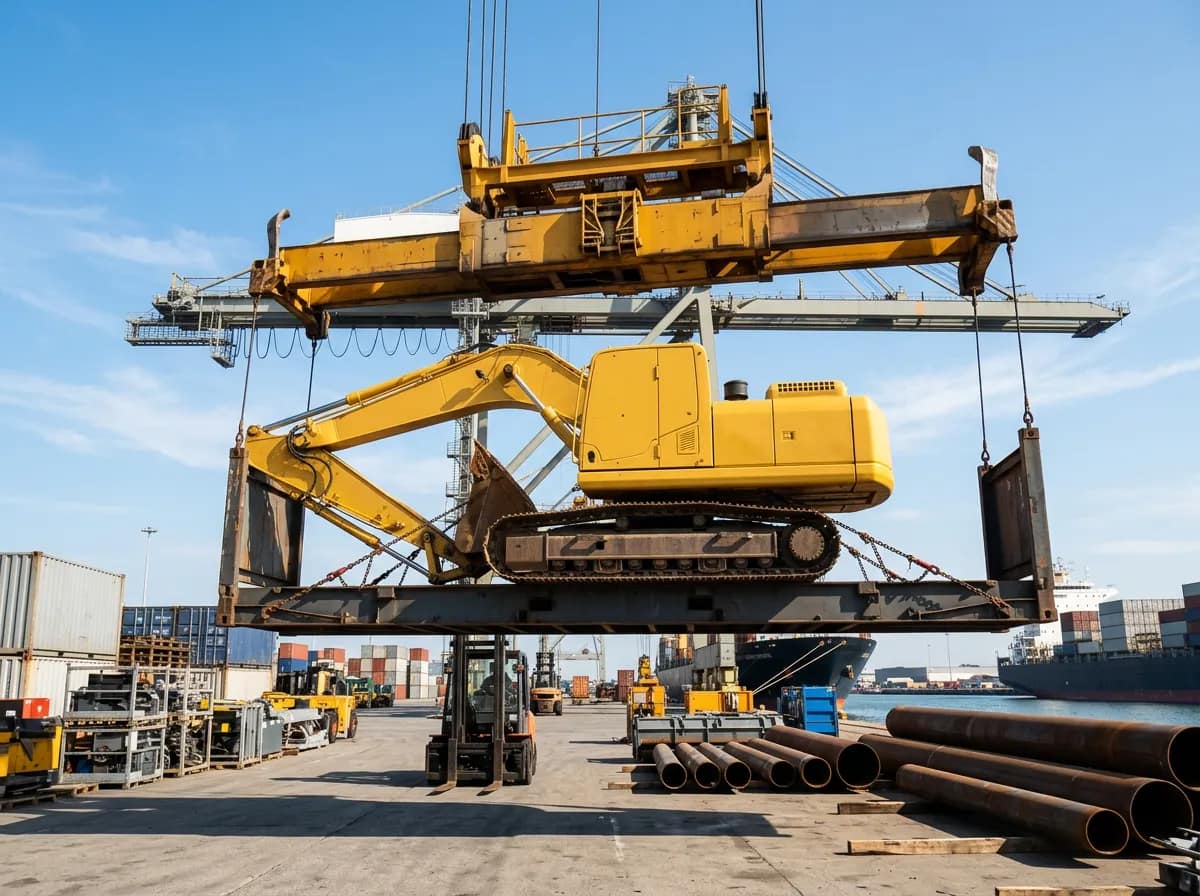
Project equipment is too big for normal containers, and the wrong method costs more. We plan each piece's transport and lashing, then clear and deliver it.
How do construction equipment and vehicles ship to Africa?
Choose the transport method case by case from each piece's size, weight and centre of gravity: anything that can drive on board goes Ro-Ro; oversize pieces go on flat racks, open tops or breakbulk, with a lashing plan.
Construction vehicles and semi-trailers that can drive on board go Ro-Ro, with no container and no dismantling.
Over-height and over-width equipment goes on flat racks, open tops or breakbulk according to size; bulk steel, rebar and other heavy cargo suits breakbulk.
You need to provide each piece's length, width, height and weight and whether it can be dismantled; we also check the lifting capacity at the destination port and the road limits for inland transport.
Imported vehicles need SONCAP certification, which we handle before shipment, checking each vehicle's chassis number (VIN) against the documents.
Common problems
01
It will not fit in an ordinary container
Construction machinery and large equipment are too tall, wide or heavy for standard containers. Many providers cannot quote, and it is unclear which container or vessel type to use.
02
The wrong transport method costs a lot more
Ro-Ro, flat racks, open tops and breakbulk are all charged differently. Construction vehicles are large and expensive, so choosing the right method saves a substantial amount.
03
Destination port and inland conditions not checked
If the equipment cannot be unloaded at the port, or inland roads have height or weight limits it cannot pass, delivery to site is delayed.
04
Vehicle documents do not match the vehicle
Imported construction vehicles need SONCAP, and a chassis number (VIN) that does not match the documents holds up clearance.
Our approach
Transport methods compared case by case
We compare breakbulk, flat rack, open top and Ro-Ro by size and volume, and work out the total door-to-door price of each option for you to compare.
Professional lashing plans
We plan the lashing from the cargo's size, weight and centre of gravity: reliable space on Ro-Ro vessels, and professional lashing on flat racks and open tops.
Destination port and inland conditions checked
Before shipment we check the destination port's lifting capacity and unloading conditions, and the road limits for inland transport, to confirm the equipment can be unloaded, moved and delivered to site.
Vehicle certification and document checks
Imported vehicles need SONCAP certification. We handle it before shipment and check each vehicle's chassis number (VIN) against the documents.
Duties are included for Nigeria only. Morocco prices exclude import duty and VAT.
Customer stories
Project cargoConstruction contractor, Lagos
Oversized equipment delivered to site in one shipment
Chief AdeProject manager
“Equipment dimensions, clearance and lifting were all arranged in advance. It could be unloaded the moment it reached site — no running to the port ourselves to chase contacts and wait for release.”
ManufacturerManufacturing company, Ibadan
Packaging equipment delivered to the factory, with truck access and unloading confirmed in advance
Engr. AdebayoHead of procurement
“They asked in advance about the crate sizes, which trucks could enter the site and how unloading would work — even who was responsible for lifting. By the time the delivery notice came, we had a forklift and people ready.”
FAQ: Project and engineering cargo
01How is very large equipment shipped?
First we need the equipment's length, width, height and weight and whether it can be dismantled. From the dimensions we judge whether it fits a standard container; if not, we assess open top, flat rack or breakbulk options, and check the lifting capacity at the destination port and the road limits for inland transport. This kind of cargo has to be assessed case by case and cannot be quoted at standard container rates.
02How are construction vehicles and semi-trailers shipped?
Vehicles that can drive on board go Ro-Ro, with no container and no dismantling; over-height and over-width equipment goes on flat racks, open tops or breakbulk according to size, with a lashing plan. Imported vehicles need SONCAP certification, which we handle before shipment, checking each vehicle's chassis number (VIN) against the documents.
03Which is cheaper, Ro-Ro or flat rack?
Ro-Ro is usually better value for vehicles that can drive on board; flat racks are for vehicles that need dismantling or cannot drive on. We compare the options by vehicle model.
04How long do breakbulk and Ro-Ro take?
Ro-Ro and breakbulk transit times depend on the current sailing schedule. Tell us when you plan to ship when you ask for a quote, and we will check the current schedule and let you know.